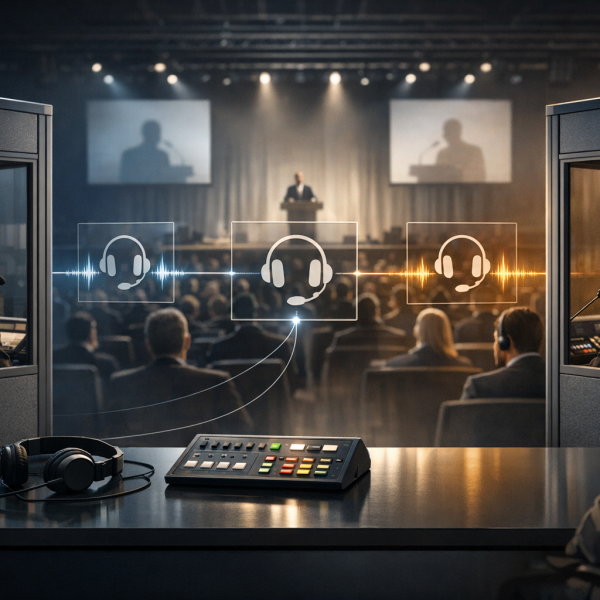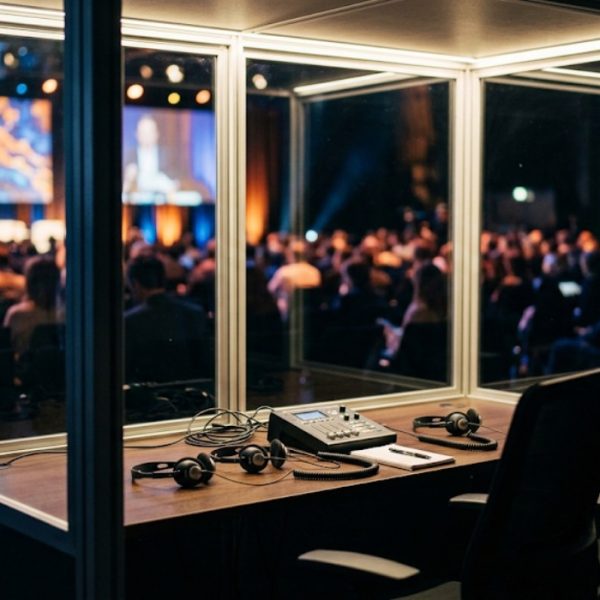
Walk to the back of a large conference hall and you will usually find a glass box about the size of a garden shed, lit from inside, with two people in headsets watching the stage. That box is where simultaneous interpretation happens, and most delegates never think about it beyond the moment their headset crackles into life. The work is supposed to look effortless from the floor. Inside the booth it is one of the most demanding jobs anyone does for a living, and knowing how it really runs will change how you brief, budget and book your next multilingual meeting.
The real work starts days before the room fills
By the time the chair opens the session, an interpreter has usually spent hours reading. Agendas, slide decks, last year's minutes, the technical annexes nobody expects an outsider to open. Out of that reading comes a glossary, often a spreadsheet with three or four columns, in which every awkward term gets a decision made in advance. A French speaker who says maitrise d'ouvrage in a construction meeting is not using a job title that maps neatly onto English, and the moment to settle that is not while the sentence is already in the air.
Which is why the most useful thing a client can send is not a longer contract but a folder of documents. Draft speeches, acronym lists, the names of everyone on the panel and how those names are pronounced. Interpreters who get that folder a week ahead sound like insiders. Interpreters who get it on the morning sound like careful strangers, and delegates hear the difference even if they cannot name it.
Why the booth always holds two people
Booths are staffed in pairs, and the pair swaps roughly every twenty to thirty minutes. That is not an invoice-padding convention. Accuracy measurably declines after about half an hour of continuous output, and the interpreter is often the last person in the room to notice it slipping. The colleague who is not on the microphone is not resting either. They are writing down figures, chasing a term that arrived out of nowhere, flagging a slide that has changed since the pack was circulated. The professional body for conference interpreters publishes staffing standards that most serious organisers now treat as a floor rather than a nicety.
The equipment carries more than sound
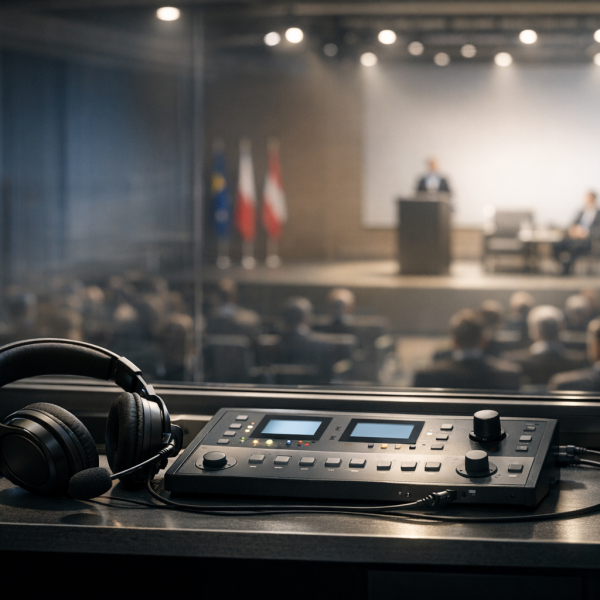
A proper booth is a small acoustic room. Sealed glass, its own ventilation, a console with a cough button so the interpreter can clear their throat without broadcasting it, and a clean feed straight from the sound desk rather than a microphone pointed at a loudspeaker. That feed matters more than almost anything else. An interpreter working from a muddy room mic loses consonants, and lost consonants become guessed numbers. When a venue offers a table-top setup instead of a full booth, ask what the audio path actually looks like before agreeing.
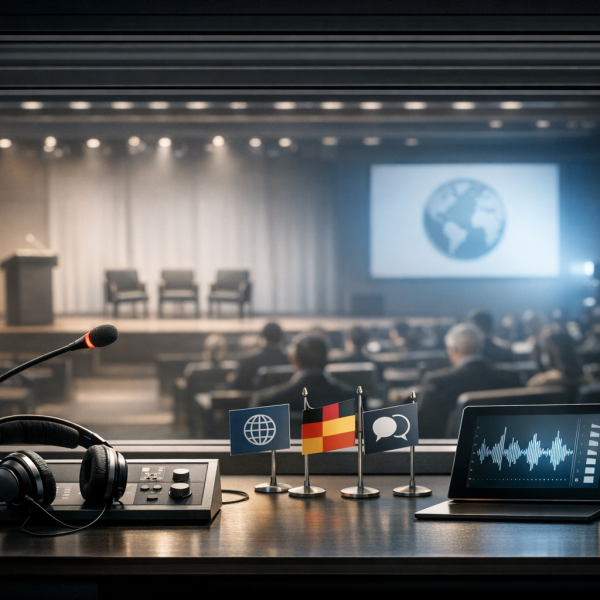
Headsets for the audience are the visible half of the system, and the channel labelling is where events usually go wrong. Delegates who cannot find their language give up within a minute and stop listening, which quietly wastes the entire interpreting budget.
Relay, and the long way round
When a meeting runs in six languages, no booth covers every pair. A Finnish speaker might be interpreted into English first, and the French, Spanish and Polish booths then work from that English version. This is called relay, and it works, but it stretches the lag and passes any ambiguity down the chain. Good organisers minimise relay by choosing the pivot language deliberately rather than by accident. In European institutional settings that pivot is frequently English or French, the latter carrying a long institutional history as a language of diplomacy that still shapes how multilingual meetings are structured today.
The booth is one answer to the problem of live language, but it is far from the only one in daily use. For a short medical appointment, a council enquiry or a legal intake call, a full simultaneous setup is wildly disproportionate, and the same need is met by phone interpreting, where a linguist joins the line within seconds and works consecutively. The underlying skills overlap heavily, even though the working conditions could hardly be more different.
Inside the booth an interpreter is making decisions in tenths of a second, and the discipline that requires has an obvious cousin in post-production. Both jobs are about compressing meaning into a window that will not stretch. Anyone who has watched that work up close understands why good subtitling services cost what they cost.
What quality sounds like when you cannot check it
Most buyers cannot audit the output, because if they could speak both languages they would not need the service. There are proxies. Listen for whether the interpreter finishes sentences or trails off. Listen for whether numbers arrive cleanly, since figures are the first thing to break under pressure. Ask a bilingual colleague to sample ten minutes and report back honestly. And when you compare providers, look at what they ask you for. Teams offering serious conference interpreting services will interrogate your agenda, your speaker list and your room layout before they quote. Anyone who quotes on a headcount and a date alone has not understood the job.
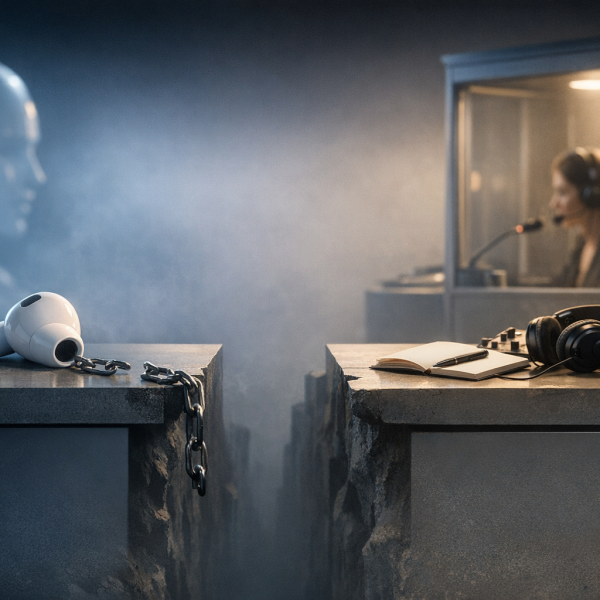
What actually happens during simultaneous interpretation is cognitive rather than mechanical: the interpreter is predicting, compressing and repairing continuously. Understanding that explains why the role resists automation. It also explains where communication gaps appear when the work is done badly.
Remote booths moved the geography, not the work
Since 2020 a large share of simultaneous interpretation has run through remote platforms, with the interpreter in a studio or a treated home office rather than at the venue. The cognitive load did not change. What changed is that audio quality became the client's responsibility as much as the venue's. Speakers on laptop microphones, in echoing rooms, reading fast from a script, produce the conditions that make remote work genuinely harder than being in the hall. A twenty pound wired headset for every speaker solves more interpreting problems than any amount of platform tuning.
How to get more out of the booth you are paying for
Send materials early, and send them again when they change. Ask speakers to slow down when they read prepared text, because read speech runs far faster than spoken thought. Give the interpreters five minutes with the chair before the session so they know the running order. Put the booth where it can see the screen and the speaker, not behind a pillar. None of this costs money, and all of it raises the ceiling on what your interpreters can deliver.
The technique has been in continuous use since the post-war trials at Nuremberg, and the fundamentals have barely moved: two trained people, clean sound, good preparation, and enough respect for the difficulty to stop treating the booth as furniture.